Situations by age · Ages 13-18
On the phone late, can't get up: what helps
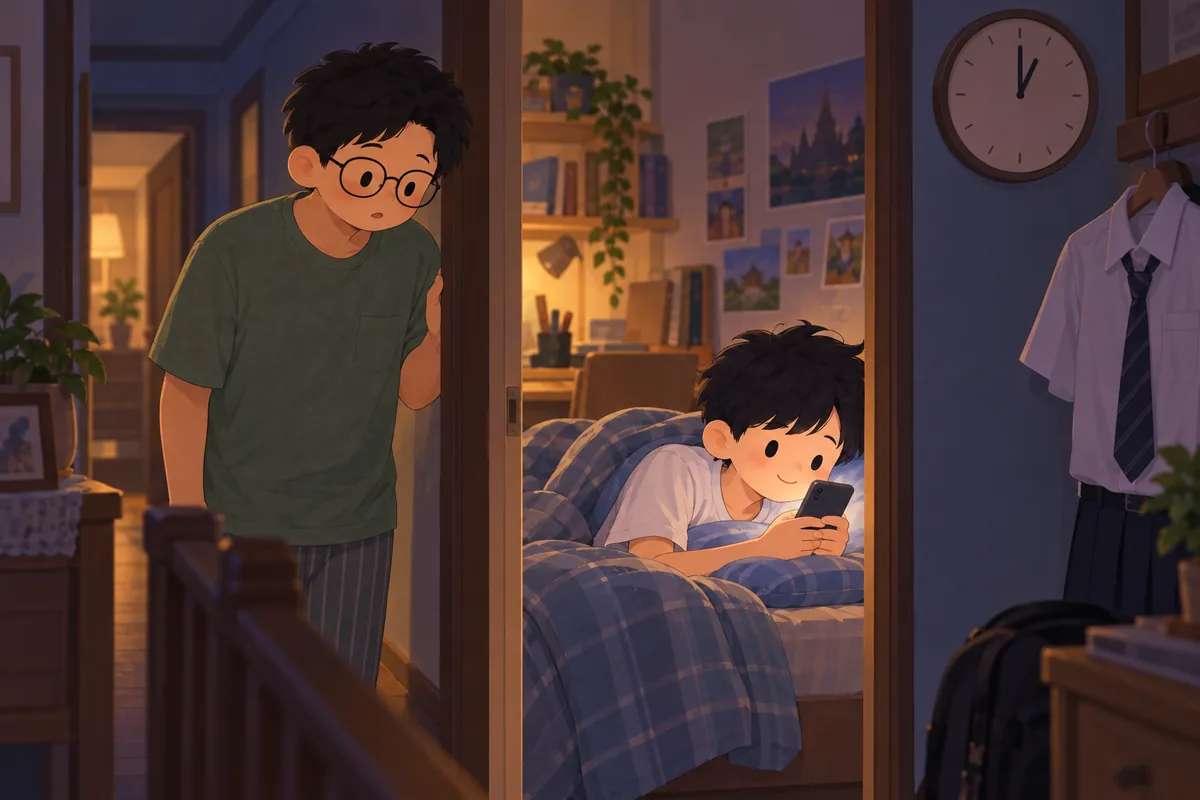
The moment
Past 1 a.m., Mum or Dad gets up for the bathroom and sees phone light glowing from your child's room, with quiet laughter as they chat with friends. In the morning, Mum or Dad calls them three times and your child still won't get up: late for school for the third time this week. Then the homeroom teacher messages on LINE to say your child often falls asleep in class.
What your child may be feeling
A teen's body clock really does shift later, so your child may not feel sleepy at 10 p.m. Night is also the only time to chat with friends without anyone giving orders, so putting the phone down can feel like dropping out of the group.
What to do in the moment
- Talk at a calm time, not at 1 a.m. Look together at how teens need eight to ten hours of sleep, then count back from wake-up time to decide when the phone goes down.
- Agree on a charging spot outside bedrooms, like the living room, for everyone in the house, Mum or Dad included. If your child uses the phone as an alarm, get them a simple alarm clock.
- Let your child tell their group themselves, “I'm offline at 10:30 on school nights.” Try it for one or two weeks, then talk about whether mornings feel different. If your child keeps to the deal, the time can loosen up.
Try saying this
“I don't want to take your phone. I'm just worried seeing you so wiped out every morning. Can we agree on what time phones go down on school nights, and where they charge?”
Instead of “You're hooked on that thing and throwing your future away. Hand it over. It's gone for a month.”
Why it helps
The American Academy of Pediatrics (AAP) recommends 8–10 hours of sleep a night for ages 13–18, and screens off about an hour before bed. At puberty the body clock can shift up to about two hours later, so a phone that sleeps outside the room helps more than scolding. The US National Institute of Mental Health (NIMH) explains that too little sleep makes it harder for teens to pay attention, control impulses and do well at school. In Thailand's 2021 student health survey (GSHS), about 2 in 3 students aged 13–17 (64.3%) spent 3 or more hours a day sitting with screens, games or chatting with friends outside school and homework. If your child still can't sleep for weeks even without the phone, or is so sleepy it affects school, talk to a doctor.
Source: AAP HealthyChildren.org, Healthy Sleep Habits: How Many Hours Does Your Child Need? (2026); American Academy of Sleep Medicine, sleep duration recommendations (endorsed by AAP); NIMH, The Teen Brain: 7 Things to Know; WHO/Thai Ministry of Public Health, GSHS Thailand 2021 Fact Sheet
Every child handles it differently
In the app: the way that fits your child's energy (some answer at once to a yes-or-no question, some need time first), a 3-day plan to try, and a word for you.
See a professional when
If your teen can't fall asleep or can't get up for weeks even without the phone, nearly nods off while riding or travelling, or also seems sad, irritable or bored with everything, talk to a doctor.
Ideas to try and adapt, not a diagnosis. Every child is different.
Have a question about this?
Ask other parents and the Family Blueprint team in our community. Read what other homes asked first, no sign-up needed.
Ask in the community