Situations by age · Ages 0-8
Fights the car seat, wants to be held: what helps
The moment
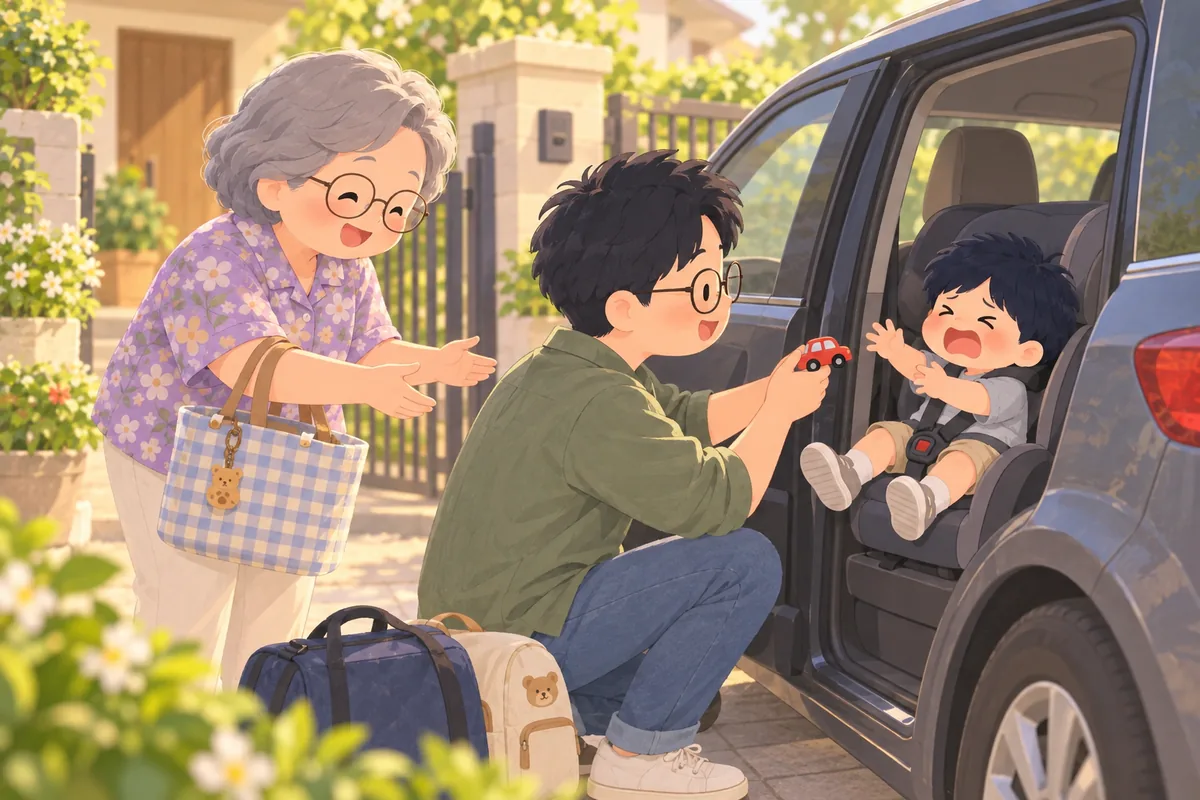
Saturday morning, the family is off to Grandma's and already late. Your child arches, screams and kicks until the car-seat straps won't buckle. Grandma holds out her arms: “Let me hold the little one on my lap. It's not far.” Mum or Dad wants the crying to stop, but doesn't want to drive off with your child unbuckled.
What your child may be feeling
Your child may feel trapped, hot or bored, and want to be close to Mum or Dad. The crying is about comfort, not defiance.
What to do in the moment
- Same rule every trip, said briefly and calmly: the car moves once your child is buckled. If your child fights it, pause and try again. Don't bargain it away, even for a short ride.
- Make the seat comfier: straps that fit, a window sunshade, a toy or song that lives only in the car.
- Talk with grandparents using reasons, not blame: in a crash, arms can't hold a child, and Thai law now asks for child seats. On a motorbike, children wear a helmet that fits, every trip.
Try saying this
“Mum or Dad knows you really don't like it. The car goes once you're buckled in. We'll sing on the way.”
Instead of “Fine, skip the seat this once. It's close, Grandma can hold you.”
Why it helps
The World Health Organization (WHO) says child restraints cut infant deaths by about 71%. Thailand's traffic law, amended in 2022, calls for a child safety seat for children aged 6 and under. The American Academy of Pediatrics (AAP) advises rear-facing for as long as the seat allows, a booster until the adult belt fits (usually at around 145 cm tall), and the back seat for children under 13.
Source: Thailand Land Traffic Act (No. 13) B.E. 2565 (2022), s.123 (child safety seat for passengers aged 6 and under; enforced under a Royal Thai Police regulation from 17 Aug 2023) and s.122 (helmets for riders and passengers); WHO Road traffic injuries fact sheet (2026); AAP HealthyChildren.org “Car Seats: Information for Families” (updated 2026); Dr Adisak Plitponkarnpim, National Institute for Child and Family Development, Mahidol University, on lap-holding (PPTV, May 2022)
Every child handles it differently
In the app: the way that fits your child's energy (some answer at once to a yes-or-no question, some need time first), a 3-day plan to try, and a word for you.
See a professional when
If your child was born early or has a condition that makes holding up the head or breathing harder, ask the doctor which seat suits them. Replace a seat that has been in a serious crash. If you see a child left alone in a car, call 191 or 1669 at once: a parked car can get dangerously hot within minutes.
Ideas to try and adapt, not a diagnosis. Every child is different.
Have a question about this?
Ask other parents and the Family Blueprint team in our community. Read what other homes asked first, no sign-up needed.
Ask in the community