Situations by age · Ages 14-18
Stressed about grades and entrance exams: what helps
The moment
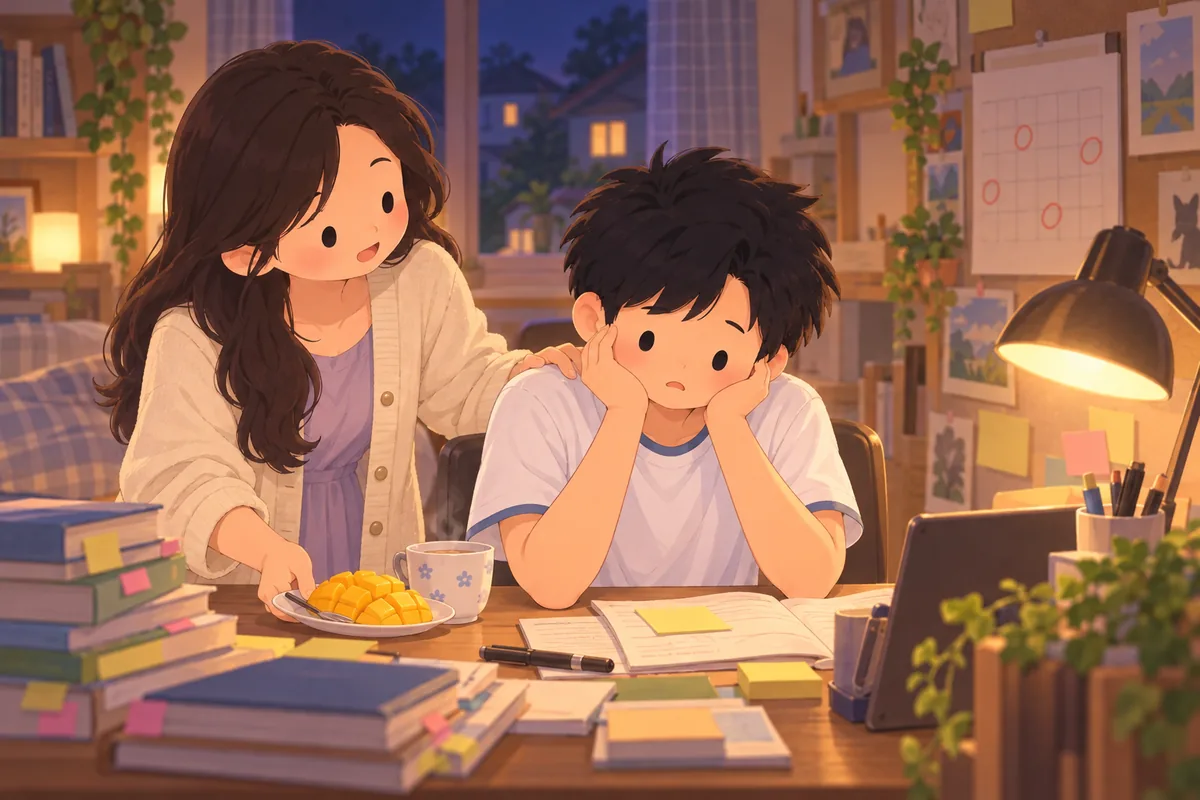
Your child is in Grade 12, with tutoring every evening and every weekend, studying until 2 a.m., often with headaches and little appetite. The night the test scores come out, your child cries, “If I don't get into medicine, my life is over.” The next day an aunt visits and mentions the neighbour's child got into a top university in the portfolio round. Your child quietly gets up and goes to their room.
What your child may be feeling
Your child may feel their scores are their worth, and fear disappointing Mum or Dad more than failing the exam. A small comparison from a relative can cut deeper than adults realise.
What to do in the moment
- Ease the pressure from home: no comparisons with other kids, ask relatives to chat about something other than scores, and make clear that Mum or Dad's hope is for your child to study something they can grow in, not a particular faculty name.
- Protect sleep and routine: plan study in blocks with a break every hour, keep half a day a week free, and aim for at least eight hours of sleep, especially before exams.
- Sit down together and go through the TCAS rounds and backup options, with your child leading on what they like. Having a plan B and C often eases the “My life is over” fear.
Try saying this
“I can see how hard you're working. Whatever the results, I'm proud of you, and there's more than one path forward. Want to sit down and look at the options together?”
Instead of “Look at the neighbours' kid, in on the first round. If you don't get in, you've only got yourself to blame.”
Why it helps
In a 2020 UNICEF Thailand survey of young people during COVID-19, more than half were worried about their studies, exams and future. The American Academy of Pediatrics (AAP) suggests letting teens lead on study choices with parents backing them, and stresses that scores don't define a person's worth. The AAP also flags fixation on one goal, with a belief that life will be ruined without it, as a sign to take seriously. Teens need 8–10 hours of sleep, and sleep loss makes memory and focus worse. If your child can't sleep or eat, often has a racing heart or can't catch their breath, or says they feel hopeless, talk to the school counsellor or a doctor.
Source: AAP HealthyChildren.org, College Entrance Exams (2019), Mental Health and Teens: Watch for Danger Signs (2025) and Healthy Sleep Habits (2026); UNICEF Thailand, youth survey (2020); Council of University Presidents of Thailand, mytcas.com (TCAS rounds); Department of Mental Health Thailand, 1323 hotline
Every child handles it differently
In the app: the way that fits your child's energy (some answer at once to a yes-or-no question, some need time first), a 3-day plan to try, and a word for you.
See a professional when
If stress leaves your teen unable to sleep or eat for weeks, often with a racing heart or short of breath, or avoiding everyone, talk to the school counsellor or a doctor. If they say they don't want to live if they don't get in, talk about death, or hurt themselves, ask them directly about thoughts of self-harm, don't leave them alone, and call the 1323 mental health hotline (free, 24 hours). If there's immediate danger, call 1669.
Ideas to try and adapt, not a diagnosis. Every child is different.
Have a question about this?
Ask other parents and the Family Blueprint team in our community. Read what other homes asked first, no sign-up needed.
Ask in the community