How to read a Human Design chart, step by step
If you've ever searched for how to read a Human Design chart, this moment may feel familiar. The first time people open their own chart, the reaction is often the same: "what am I looking at?" Triangles, squares, some shapes colored in, some left white, lines running everywhere, numbers all over, and two columns of red and black numbers down the side. It looks more like a circuit board than a person.
Feeling lost the first time is normal. Trying to understand every last detail in one go usually just wears you out.
The good news: learning how to read a Human Design chart as a beginner doesn't mean reading everything at once. Look at four things, in order, and the picture starts to come together. The rest can wait.
If you're not sure yet what Human Design is, it's worth reading What is Human Design? A beginner's guide first, then coming back here.
What a Human Design chart actually shows (the big picture)
A Human Design chart is an energy chart calculated from your date, time and place of birth. It's drawn as the outline of a body with nine shapes running from the head down to the base.
Here's a simple way to look at it:
- The nine shapes are energy centers. Some are colored, some are white.
- The lines between centers are channels, where energy is said to flow.
- The small numbers on the chart are gates, smaller points inside each center.
- The red and black numbers down the side are the data the whole chart is calculated from.
When you're starting out, you can set those last two aside. No guilt.
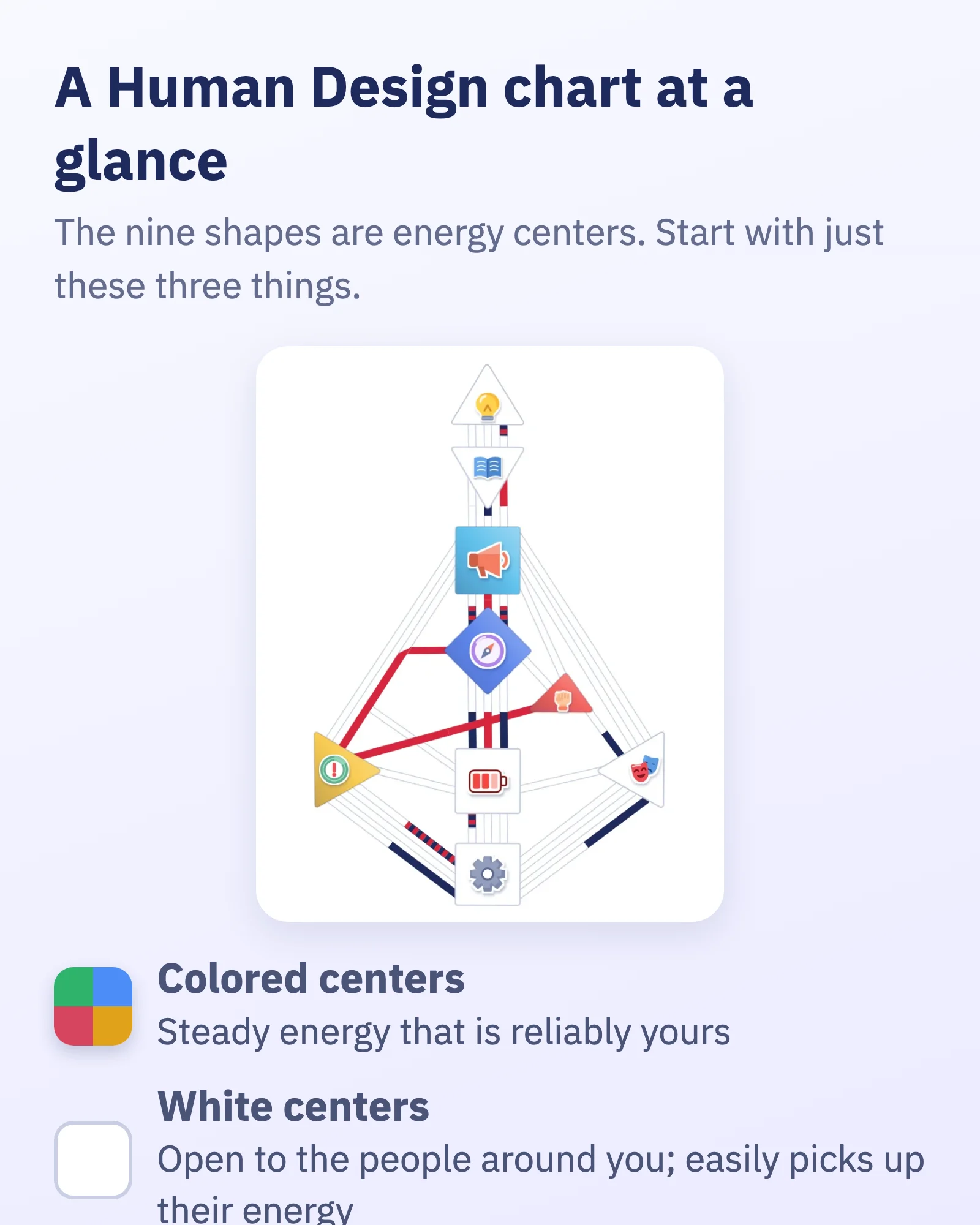
In the Family Blueprint app, each center shows as an icon instead of numbers; tap an icon to read about that center.
Step 1: Start with your type
Type is where most people begin, because it gives the widest view of how the system sees you using energy and getting things started. There are five.
- Generator has steady, lasting energy and does well responding to what comes to them.
- Manifesting Generator has Generator energy but moves fast and juggles several things at once.
- Projector sees other people clearly, works in bursts with rest in between, and guides well when invited or asked.
- Manifestor likes to start new things on their own; home runs more smoothly when they let people know before acting.
- Reflector mirrors the atmosphere around them, takes longer over big decisions, and is the rarest type.
Try not to guess your child's type from their personality. Type isn't read from behavior; it comes from which centers are colored and how they connect on the actual chart.
Step 2: Look at your authority
This is usually listed right next to type. It describes how the system invites you to "listen to yourself" before making important decisions. For example:
- Some people are invited to wait until they feel settled, because emotions come in waves that rise and fall.
- Some are invited to listen for an immediate gut response, an "uh-huh" or "unh-unh".
- Some are invited to trust their first, in-the-moment feeling.
- Some are invited to talk it through with someone they trust and listen to their own voice as they speak.
For me, this is the most usable part at home. If your child is the wait-until-settled kind, pushing for an answer "right now" may not help much. Try giving them a night, and see whether the answer changes.
Step 3: Look at your profile (the pair of numbers)
Your profile is a pair of numbers like 1/3, 2/4 or 6/2. There are twelve in total. The system sees the first number as the side of you that you're aware of, and the second as the side other people tend to notice in you more.
You don't need to learn what every number means. Read the description of your own profile and just ask: "which parts feel like me, and which don't fit at all?" Both answers are equally useful.
Step 4: Look at the colored and white centers
Now go back to those nine shapes.
- Colored centers are where your energy is fairly consistent, the steady parts of you.
- White centers are the parts that are sensitive to people around you, picking up and reflecting other people's energy.
Here's one many parents recognize: if the emotional center (Solar Plexus) on your chart is white, on days your child is cranky you might find yourself getting cranky too, without noticing. Knowing that won't make the irritation vanish, but it lets you ask yourself, "is this mine, or did I pick it up from someone at home?"
A white center doesn't mean something is missing or weaker. A colored one doesn't mean better. They're simply different.
Try reading your chart this way for a week
You don't need to reach any conclusions yet. Try this first:
- Pick just one thing. Maybe your authority, or one white center.
- Watch for it in real life for a week. A few quick notes on your phone is plenty: when did it fit, when didn't it?
- Talk it over with someone you trust. Your partner, a friend, someone at home. Saying it out loud often shows you more than thinking it through alone.
- Read your own chart before your child's. Understanding yourself a little first makes it much easier to read your child's chart calmly.
If none of it fits, that's fine. Set it aside and try something else. Finding out that something doesn't fit is useful information too.
Using a Human Design chart with peace of mind
Human Design is an energy-based system that research has not confirmed, so I treat a chart as a map to help you notice, not a verdict on who someone is. Your child doesn't have to be what the chart says, and doesn't have to be what we expect either. Kids grow and change all the time.
In Family Blueprint, we calculate a chart for everyone at home and turn it into an energy guide you read one chapter at a time, so you don't have to decode the shapes and numbers yourself. If you'd like to see what that looks like first, take a look at the Human Design chart page.
Curious what your child is like?
Family Blueprint calculates an energy chart for everyone at home and writes it up as an easy-to-read guide for noticing and talking together.
Start freeSee plans and pricesIf you're worried, it's always fine to ask a professional
A chart is no substitute for a doctor. If you're concerned about the development, emotions or mental health of anyone at home, talk to a pediatrician, psychiatrist or psychologist. It doesn't mean something is wrong; it just means someone else is helping you look.
This article is a perspective for reflection and learning. It is not a diagnosis and does not promise any result.
Questions parents often ask
Can I read a chart without an exact birth time?
Yes, but some parts of the chart can change if the time is off by just a few minutes. If you can, check the birth certificate or ask someone who was there.
Does the chart change as my child grows?
The chart is calculated from birth data, so it stays the same. Your child, though, keeps growing and changing, which is why the chart is only a starting point for noticing, not a box to live in.
My child's chart doesn't match what I see at all. What now?
Trust what you see in your real child first. You're with them every day and know them better than any chart. Set aside the parts that don't fit, and come back to them later if you like.
Try your family's energy guide
Add the birth date, time and place of the people at home, then read the ideas that fit each of them. Try one at a time and keep only what works for your family.
Start freeSee plans and pricesHave a question about this?
Ask other parents and the Family Blueprint team in our community. Read what other homes asked first, no sign-up needed.
Ask in the communityKeep reading
 Manifesting Generator in Human Design: for parents and kidsWhat is a Manifesting Generator in Human Design? Why some people juggle many things, move fast and skip steps, and how to make that energy easier at home.
 Family problems and solutions you can start at homeCommon family problems, from the same old fights to talking less and running on empty, and five small solutions you can start at home today, one step at a time.
 How to find yourself when you don't know what you likeHow to find yourself when you feel lost and don't know what you like: five small ways to start noticing yourself again, for working adults, parents and teens.