Manifesting Generator in Human Design: for parents and kids

If you're looking up what a Manifesting Generator is, see if an evening like this sounds familiar.
Your child does two homework questions, gets up to add a few blocks to a tower, wanders back to doodle in the corner of the notebook, and keeps a toy car in one hand the whole time. Watching it makes you uneasy, and you want to say, "Can you do one thing at a time, please?" Yet by the time homework is due, it's done, the block tower is done, and there's a new drawing too.
Or maybe it's you. You're answering work messages, packing lunch boxes and planning the weekend trip all at once. The rest of the family is still catching up on the first thing while you've already moved on to the third.
If this type has shown up in your child's Human Design chart, or yours, let's go through it together. I'll share what this fast, many-things-at-once energy looks like in a real home, and a few things you can try as soon as this evening.
If Human Design is a new term for you, you can start with What is Human Design? A beginner's guide.
What is a Manifesting Generator, in short
Manifesting Generator is one of the five types in Human Design. In the Family Blueprint app the Thai name is นักสร้างว่องไว, roughly "the quick builder." Human Design says about one in three people are this type, so it wouldn't be surprising to find one in your home.
The long name comes from a mix of two kinds of energy. One side is like a Generator: lots of energy for things the gut says yes to. The other side has some of the speed of a Manifestor: once they've decided, they want to get going.
From Human Design's point of view, Manifesting Generators tend to stand out in a few ways:
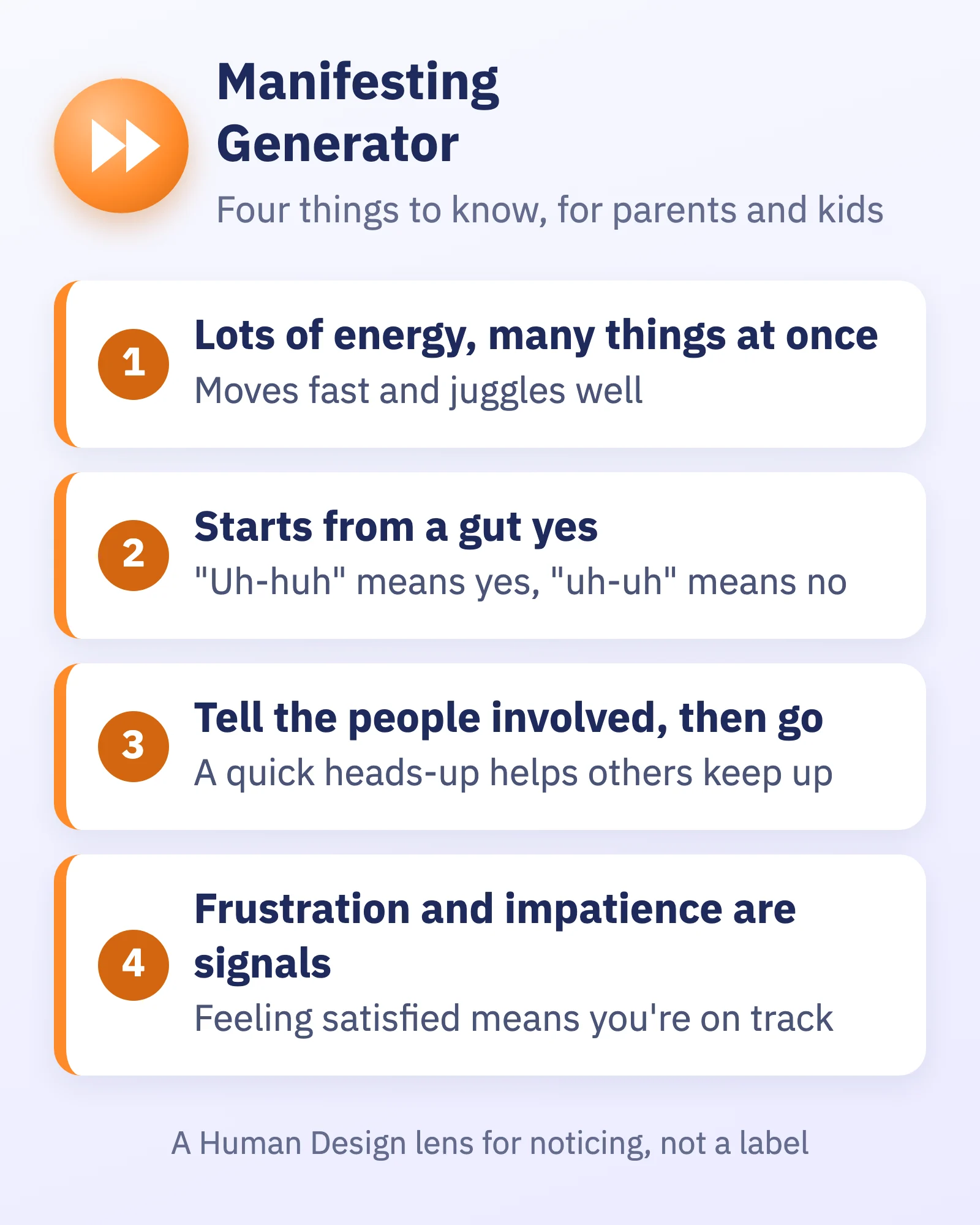
- Lots of energy, many things at once. They move fast, switch between tasks well, and often spot a shortcut before anyone else.
- They start from a gut yes. Like Generators, they wait for something to come along, then listen for the inner answer: "uh-huh" (yes) or "uh-uh" (no).
- They tell the people involved, then go. Once the gut says yes, they tend to take off. A quick heads-up to the people around them keeps anyone from being left behind.
- Frustration and impatience are signals. If these show up a lot, check whether they're pushing through something the gut never said yes to, or skipping steps and having to go back and fix things. A sense of satisfaction means they're on track.
Type comes from the chart, not from guessing who can't sit still. A Manifesting Generator is someone whose Sacral center (the life-force center) is colored in, and who has a motor center (the Sacral, Root, Solar Plexus or Heart) connected to the Throat center (the communication center), either directly or through other centers. If the Sacral is colored in but there's no connection like that, the person is a Generator instead. You can see how to find this in How to read a Human Design chart.
If your child is a Manifesting Generator, notice these four things
Hold each one up against the real child in your home. If a point doesn't sound like your child, just set it aside.
1. Let them choose the order
Many families plan the evening for their kids one step at a time: bath, dinner, homework, pack the bag. Human Design suggests kids like this often do better if you tell them what needs doing and let them choose where to start. Some will do half the homework, pack their bag, then come back to finish. If everything is done before bed, the order can be theirs.
2. Give a heads-up before switching
A child who's in full flow with something often gets very frustrated when told to stop right now. Try a five-minute warning, like "In five minutes we'll go for a bath. What do you want to play until then?" They get a moment to get ready for the change, and they get to choose how to spend those last five minutes.
3. Switching a lot may be how they find what fits
Today it's drawing, tomorrow it's dance, next week it's guitar. Many parents start to worry their child never sticks with anything. Human Design sees trying many things as the way a Manifesting Generator learns. Instead of "You never finish anything," try asking, "Which one do you want to finish first today?" They still get to try lots of things, and they practice finishing one at a time.

4. Skipping steps is fine, with one quick check at the end
Speed is one of your child's strengths, but sometimes they skip a step and have to go back and tidy up, like racing through math and forgetting to carry the one. Instead of slowing everything down, agree that before handing it in, you'll check just the one step they usually miss. They still get to go at their own pace, and you can see whether the work comes out more complete.
If you're a Manifesting Generator parent
If we're this type, we're often the ones who keep the household moving. When we think of something, we just do it. But some days the family can't tell when the plan changed, and we start getting impatient with people who move slower.
Here are three things to try:
- Give a heads-up before changing plans. We change our minds quickly, and there's nothing wrong with that. Just give your kids a one-line heads-up, like "This evening let's go to the park instead of the market." It gives them a chance to keep up, so they're less likely to feel dragged around.
- When your child starts telling you something, put everything down for three minutes. People who are good at doing many things at once often listen to their kids while doing something else, and some kids can tell we're not fully there. Put the phone down, turn off the stove, and turn toward your child fully. Then notice whether your child keeps talking a little longer.
- Tell a gut yes apart from a head that's just excited. Every new idea feels worth saying yes to, until the whole week is full. Before taking on something new, ask yourself whether your gut really says "uh-huh." If it's still unclear, tell your partner or a close friend about the idea once, and listen to your own voice as you finish: are you still excited?

Doing many things versus never finishing
Parents ask about this a lot. If I let my child switch back and forth, won't they grow up unable to finish anything?
Look at how the day ends. If your child switches around but what needs finishing gets finished, and they seem bright and happy, that may simply be their natural rhythm. But if the switching comes with frustration, everything left half done, and no joy in any of it, it may be time to help them put a few things down. Homework still gets done and bedtime is still bedtime; you set those. How your child zigzags to get there can be theirs. Watch for a couple of weeks, then see what your family needs.
How to use the Manifesting Generator idea without worry
Human Design is an energy system, and science hasn't backed it up. I reach for it when I want to understand why a child moves that fast. If you ever hear yourself say "well, they're a Manifesting Generator" to let things stay unfinished, or to complain that they can't sit still, it's being used the wrong way. Your child can still grow into anyone. I'm still trying things and adjusting every week too.
If you'd like to know who in your home is a Manifesting Generator, add each person's birth date, time and place in the Family Blueprint app, then read that person's energy guide chapter by chapter, on how this energy works in a child or in an adult. The app also gives small things to try each day, for each person. The family map shows how one person's fast pace fits with everyone else's. It's all a tool for noticing. You're still the one who knows your child best.
Curious what your child is like?
Family Blueprint calculates an energy chart for everyone at home and writes it up as an easy-to-read guide for noticing and talking together.
Start freeSee plans and pricesWhen you're worried, talk to a professional
If focus, sitting still or finishing tasks is affecting school or friendships a lot, or your child's teacher is starting to worry, or your child seems unhappy and uninterested in everything for weeks, don't put it down to their chart type, and don't try to work out on your own what might be going on. Talk with a pediatrician or a child psychologist first. A chart is just one more way of looking at your child. Questions about development and health are for a professional to help with.
This article is a perspective for reflection and learning. It is not a diagnosis and does not promise any result.
Questions parents often ask
What's the difference between a Manifesting Generator and a Generator?
Both have a colored-in Sacral center, and both start by noticing whether the gut says yes. The difference is that a Manifesting Generator has a motor center connected to the Throat, so they tend to act quickly, juggle several things and look for shortcuts. A Generator more often likes to stay with one thing for a long time and get better at it bit by bit.
What's the difference between a Manifesting Generator and a Manifestor?
Both move fast, and both do better when they tell the people around them before acting. But a Manifestor has a white Sacral, starts new things without waiting, and needs rest between bursts. A Manifesting Generator has a colored-in Sacral, so Human Design suggests waiting for a gut yes first, then taking off.
My child does many things at once all the time. Does that mean they're a Manifesting Generator?
You can't tell from that alone. Lots of kids switch quickly at their age, whatever their type. Type comes from a chart worked out from birth date, time and place. Then you hold it up against the child you see every day.
Try your family's energy guide
Add the birth date, time and place of the people at home, then read the ideas that fit each of them. Try one at a time and keep only what works for your family.
Start freeSee plans and pricesHave a question about this?
Ask other parents and the Family Blueprint team in our community. Read what other homes asked first, no sign-up needed.
Ask in the communityRelated situations, with words you can use
 Refusing homework: what helpsRefusing homework? Your child may feel the work is too big to start, or be afraid of getting it wrong. Getting up again and again can be a way to escape…
 Fighting over the tablet: what helpsFighting over the tablet? Your child may be so absorbed that stopping midway feels really hard, and it may seem unfair because it isn't clear when their…
 Asked to help, they moan and don't: what helpsAsked to help, they moan and don't? Chores can feel boring, and your child is used to adults doing them. Being asked out of the blue mid-rest feels unfa…
Keep reading
 Family problems and solutions you can start at homeCommon family problems, from the same old fights to talking less and running on empty, and five small solutions you can start at home today, one step at a time.
 How to find yourself when you don't know what you likeHow to find yourself when you feel lost and don't know what you like: five small ways to start noticing yourself again, for working adults, parents and teens.
 Manifestor in Human Design: what it means for parents and kidsWhat is a Manifestor in Human Design? Why some kids want to start things themselves, how telling first helps at home, and what anger may signal.