How to find yourself when you don't know what you like
A whole free weekend, and when you ask yourself "What do I want to do?", nothing comes.
You end up scrolling your phone until it gets dark.
Someone asks about your hobbies and you just smile awkwardly.
And a teenager about to pick a college major stares at the application and wonders, "What do I even like?"
If you're trying to find yourself and honestly don't know what you like, I want to say this first: you're far from the only one. It happens to people who have been in the same job for years, to parents who have lived for their kids until they lost track of themselves for a while, and to teenagers who get asked about their future almost every day. It doesn't mean you're empty or that there's nothing good in you.
Here's how I like to see it. You haven't lost yourself somewhere. You just haven't had the time to really notice yourself yet, and that picture can get clearer, bit by bit, from ordinary everyday life.
Below are five things you can start today. You don't need all of them. Pick the one that feels closest to where you are.
Why it's so hard to find yourself
See which of these sounds most like you.
- You've lived by other people's expectations for a long time. You studied what your family wanted and took the safe job, and never really got to ask whether you wanted it.
- You're too tired to have any space left. Work, the house, the kids. The day is gone before you get any time of your own.
- You're waiting for "the one thing." You think there should be one big passion, and when it doesn't show up, it feels like you have nothing.
- You're afraid of choosing wrong, so you never quite choose.
- You compare yourself on social media. Everyone else seems to know their path, which makes you feel even more lost.
If you see yourself in several of these, that's completely fine. Most of us do.
1. Swap "What do I like?" for "What gives me energy?"
"What do I like?" is so big it's hard to answer. Try a smaller question you can answer from what happened today.
Every evening for seven days, write two short lines:
- What did I do today that made time fly or left me with more energy?
- What did I do today that drained me or felt like a slog?
They don't have to be big things. Helping a friend solve a problem, tidying a desk, talking with a customer, cooking dinner, anything counts. At the end of the week, read it back. You'll often spot something that keeps coming up, something you never noticed before.

2. Look back at what you did as a kid when nobody told you to
Think back to being a kid, on a day with no homework and nobody telling you what to do. What did you spend your time on? Drawing, building things, making up stories, leading your friends in a game, or quietly reading on your own?
You don't have to go back to doing exactly the same thing. But what you did when nobody expected anything from you often holds a clue. If you can't remember, ask your parents or an old friend, "What was I like as a kid?" Sometimes other people remember us more clearly than we remember ourselves.
3. Try small things with no strings attached
A lot of us try to find ourselves by thinking, and think until we're worn out without getting anywhere. A lot of what we enjoy only shows up once we actually try it.
Set up small experiments: one online class, a new recipe once a week, a day of volunteering, or one watercolor painting. Keep it short, about two weeks, then ask yourself whether you still want to keep going.
If it turns out you don't like it, that's not wasted. Knowing "this isn't it" is useful information too. I believe getting to know yourself is just trying, getting it wrong and adjusting as you go. Nobody finds the answer on the first try.

4. Separate other people's "should" from your own "want"
Write down five things you feel you "should" do with your life. Then ask about each one, "Whose voice is this?" Your parents', a teacher's, society's, or your own?
Keep the ones that really are yours. Some belong to other people, and you've carried them so long they started to feel like your own. Just seeing where they came from often makes things feel lighter.
Another thing that helps a lot is saying it out loud. Tell someone you trust what's on your mind, and ask them to just listen for now, no advice yet. Often, once you hear yourself talk, you'll know which sentence feels like "Yes, that's me."
5. Give yourself some space first
If you have no time of your own all day, it's hard to find anything, no matter how much you want to. The voice inside is just too quiet to hear.
Try setting aside 20 to 30 minutes a day, or half a day a week, that isn't for anyone else. Rest, take a walk or just sit quietly. And if you haven't been sleeping enough lately, start with getting enough sleep.
If you're a parent, or a teenager
For parents: Many people feel they disappeared after having kids and can't remember what they used to enjoy. Making a little time for yourself isn't selfish at all. Your kids get to see that grown-ups are still curious and can still try new things. And some things are fun to try together with your kids.
For teens: You don't need the answer for your whole life right now. You can try lots of things, and you can change your mind. If you have to choose a major, talk to students who are actually studying it, or try a short summer program or campus visit first. And for parents who want to help, try asking "What was the most fun part of your day?" instead of "What do you want to be when you grow up?"
How Human Design looks at finding yourself
If you've tried the ideas above and want one more angle for noticing yourself, Human Design is an energy system that uses your birth date, time and place to draw a chart, and suggests that each of us uses energy and makes decisions differently. If it's new to you, start with What is Human Design? A beginner's guide.
From this angle, two things are especially close to finding yourself:
- Type offers a big-picture view of how you tend to find what fits. Some people find it by responding to what comes their way, some when someone sees them and invites them in, and some through an urge to start that comes on its own.
- Authority suggests a way of listening to yourself before an important decision. For example, some people are encouraged to wait until their feelings settle, some to listen for a gut response, and some to talk it out and listen to themselves.
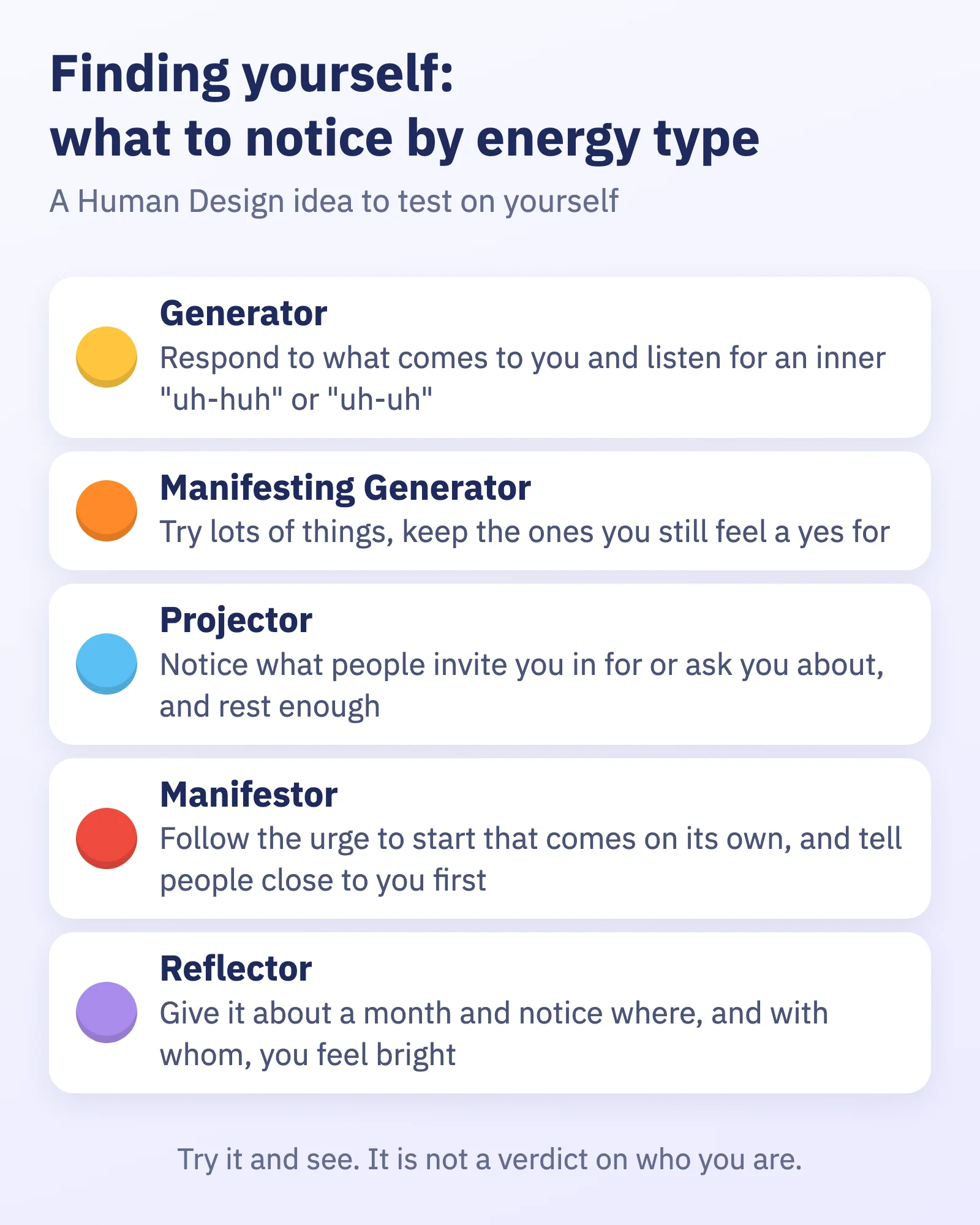
Here's one way to use it. If you know your type (if not, it comes from a chart worked out from your birth date, time and place; more on that just below), pick the line that matches you in the picture, notice it for two weeks alongside your notebook from step 1, and see whether it fits your real life. If it does, keep using it. If it doesn't, set it aside. If you'd like to read more about each type, there are articles on Generators, Projectors and Manifestors.
All of this is one angle for noticing yourself. There's no research confirming it, and it isn't here to tell you what kind of person you are or what job you should do. The one who knows best what fits you is still you, from your real life.
If you'd like to look at yourself this way, in the Family Blueprint app you just add your birth date, time and place to see your type and energy chart, and start reading an energy guide written in short, easy chapters: what kind of energy you were born with, why some things stall while others flow, and how you tend to decide best.
The guide has small things to try for three days at a time, and the app's home page has a short daily topic to help you notice yourself. Treat it as a starting point for noticing, not an answer about who you are. If you're a teen, ask a parent to sign up and add you, then read it together. (Accounts are for adults, 20 and over.)
Curious what kind of person you are?
Family Blueprint works out your own energy chart from your birth date, time and place, and writes it up as easy short chapters: how you tend to decide, what drains you and what fills you back up. A way to notice yourself, not a verdict.
Start freeSee plans and pricesIf the emptiness or low mood lasts, talk to a professional
Feeling lost can happen to anyone. But if you've felt sad, empty or uninterested in everything for more than two weeks, if your eating or sleep has changed a lot, if daily life is getting hard, or if you have thoughts of hurting yourself, please don't carry it alone. Talk to a doctor, a psychiatrist or a psychologist. In Thailand you can call the Department of Mental Health hotline at 1323, and if anyone is in danger right now, call 1669 right away. Outside Thailand, call your local emergency number or a mental health crisis line in your country. And if you're a teen feeling this way, please tell a parent, a teacher or another adult you trust.
This article is a perspective for reflection and learning. It is not a diagnosis and does not promise any result.
Frequently asked questions
Is it normal not to be able to find yourself?
Yes. Many people feel this way during a transition, like finishing school, changing jobs, having a baby, or when the kids grow up. Noticing yourself a little at a time is enough. But if you've felt empty or unable to enjoy anything for more than two weeks, please read the section on talking to a professional above.
I don't know what I like or what I'm good at. Where do I start?
The seven-day notes in step 1 are the easiest start: what gives you energy and what drains you. Then pick something that keeps showing up and try it in a small way. What you're good at usually gets clearer by actually doing things, more than by sitting and thinking.
Can Human Design tell me what career suits me?
It shouldn't be used to decide that. Your chart can help you see how you use energy and make decisions, as a starting point for noticing. Which career or major fits you depends on what you've actually tried, what interests you, and real information about the work itself.
Try your family's energy guide
Add the birth date, time and place of the people at home, then read the ideas that fit each of them. Try one at a time and keep only what works for your family.
Start freeSee plans and pricesHave a question about this?
Ask other parents and the Family Blueprint team in our community. Read what other homes asked first, no sign-up needed.
Ask in the communityKeep reading
 Manifesting Generator in Human Design: for parents and kidsWhat is a Manifesting Generator in Human Design? Why some people juggle many things, move fast and skip steps, and how to make that energy easier at home.
 Family problems and solutions you can start at homeCommon family problems, from the same old fights to talking less and running on empty, and five small solutions you can start at home today, one step at a time.
 Manifestor in Human Design: what it means for parents and kidsWhat is a Manifestor in Human Design? Why some kids want to start things themselves, how telling first helps at home, and what anger may signal.