Family problems and solutions you can start at home

It's past seven. The dishes are still piled in the sink.
One of you says, "Why does nobody ever help?"
The other says, "I literally just got home."
Your child hears it and slips off to their room without a word.
Nobody meant for it to go this way, and yet it happens again every week.
If you're looking up family problems and solutions, I want to say this first: a home going through a rough patch is not a failed home. Almost every family goes through stretches like this. What makes the difference is whether you have a way to find your way back to talking.
Let's look at the family problems many homes run into, and then at small solutions you can start on your own, at home. You don't need all of them. Pick the one that feels closest to your home.
Common family problems many homes face
- The same fight, again and again. Chores, coming home late, raised voices. Small things that pile up until they feel big.
- Talking less. Same house, but everyone is looking down at their own phone.
- Different parenting styles. One parent is strict, the other is easygoing, and the kids go to whoever says yes.
- Money and responsibilities. Bills, debt, or caring for aging parents.
- Running on empty. Working all day and having nothing left for a kind conversation at night.
- Different generations under one roof. Grandparents, parents and kids seeing the same thing in very different ways.
Have you noticed which one weighs on your home the most right now? Just naming it is already a good place to start.
1. Work on one problem at a time
When home feels off, we tend to want to sort out everything in one night, and we end up in a bigger fight than before.
Try picking the one thing that comes up most often, like who washes the dishes after dinner. Agree on just that, clearly. Give it two weeks, then check together whether it's better. If it isn't, adjust. Raising kids and living together is a lot of trying and adjusting. There's no exact formula.
2. Talk when you're calm, not while it's heated
When we're angry, we talk to win, not to understand.
Agree ahead of time, on a good day, that anyone can ask for a pause when voices start rising: "Let's take twenty minutes and come back to this." Then really come back when you said you would. A pause isn't running away, as long as you return.
Some families set a short weekly talk. Everyone sits in a circle on the floor with a plate of fruit, and each person shares what was good this week and what was hard. Little kids can join in too. It doesn't have to be formal. It just gives everyone a place where they know they'll be heard.

3. Say what you need instead of what they did wrong
"You never help with anything" and "I'm really tired today. Could you do the dishes?" are about the same thing, but they land very differently.
The first one makes the other person defend themselves. The second tells them how you feel and what you'd like. Try starting with "I feel..." and following with "I'd like...". It works with kids too: "Mom's tired. I'd like you to put your toys away before dinner."
If you can't find the words yet, try talking it through with a friend or someone you trust first. Sometimes saying it out loud once helps you see what you actually need.
4. Make the load visible
Many family problems come from feeling like "I'm the only one doing anything," while the other person may feel exactly the same, because neither of you sees the other's work.
Sit down and write a list of everything it takes to run your home together: the visible work, like cooking, and the invisible work, like remembering the kids' doctor appointments or paying the bills. Then split it again in a way that fits each person's time and energy. Kids can have their own jobs for their age. Money works the same way: put the numbers where you can both see them, rather than letting one person carry the worry alone.
5. After a fight, go back and repair
Every family argues. What helps most is going back to repair things afterward.
If you spoke harshly to your partner or your child, once you've calmed down, go back and say it plainly: "I didn't speak kindly just now. I'm sorry." No long explanation, no lesson tacked on. Kids who see adults apologize often learn that people can argue and still love each other.
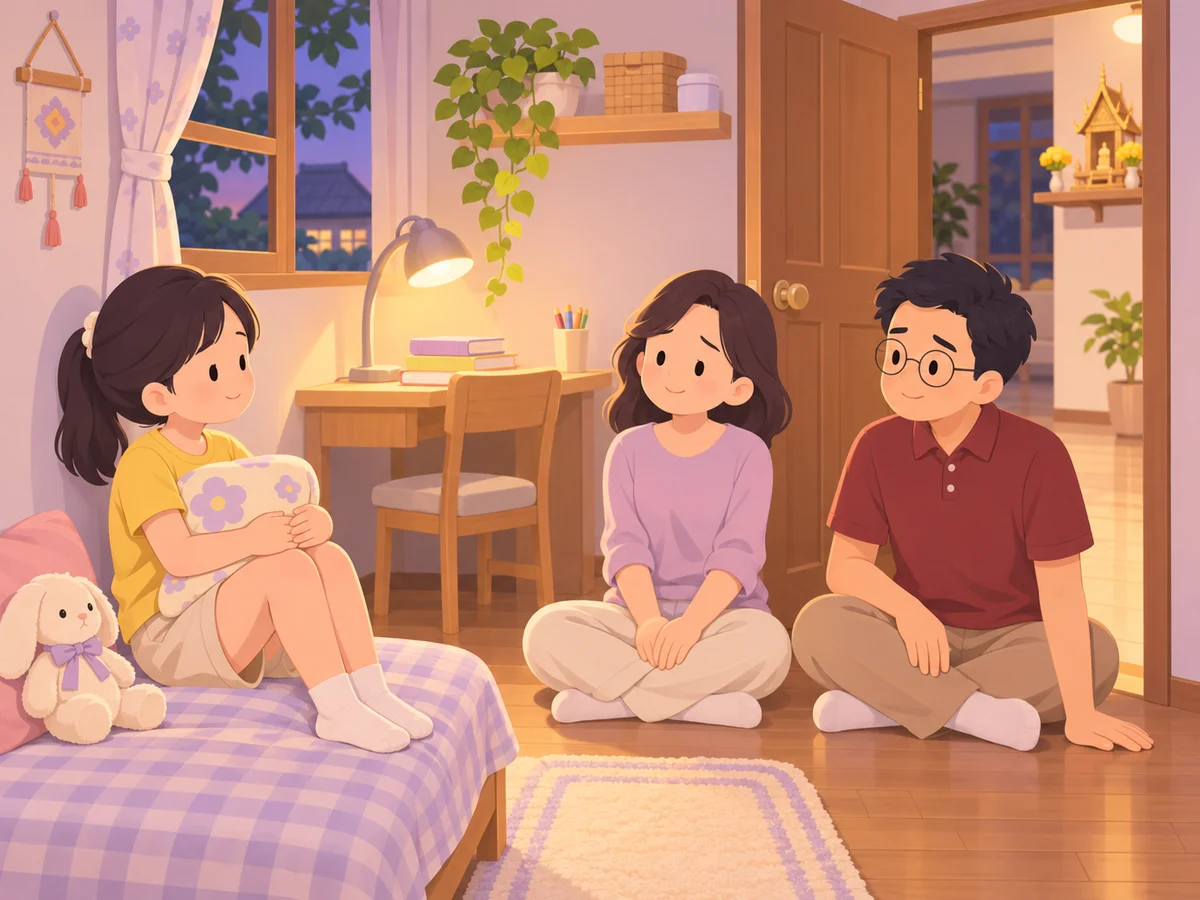
Something else that helps: small moments together with nothing to fix. A walk after dinner, or ten minutes of cartoons with your kid. Homes that have good moments saved up often get through the hard stretches together more easily.
How Human Design looks at family problems
Human Design is an energy-based system that sees each person in a home as making decisions and using energy in their own way. If it's new to you, start with What is Human Design? A beginner's guide.
From this angle, some family problems don't come from anyone being wrong. They come from expecting others at home to work the way we do. The example closest to everyday arguments is the Emotional wave (Solar Plexus) center in the chart.
- If this center is colored in, that person's emotions tend to rise and fall in their own wave. Waiting for calm before deciding on big things may help hard conversations go better.
- If this center is white, that person tends to pick up the feelings of people around them quickly. Sometimes the irritation they feel may be something picked up at home. Try asking, "Whose feeling is this?"
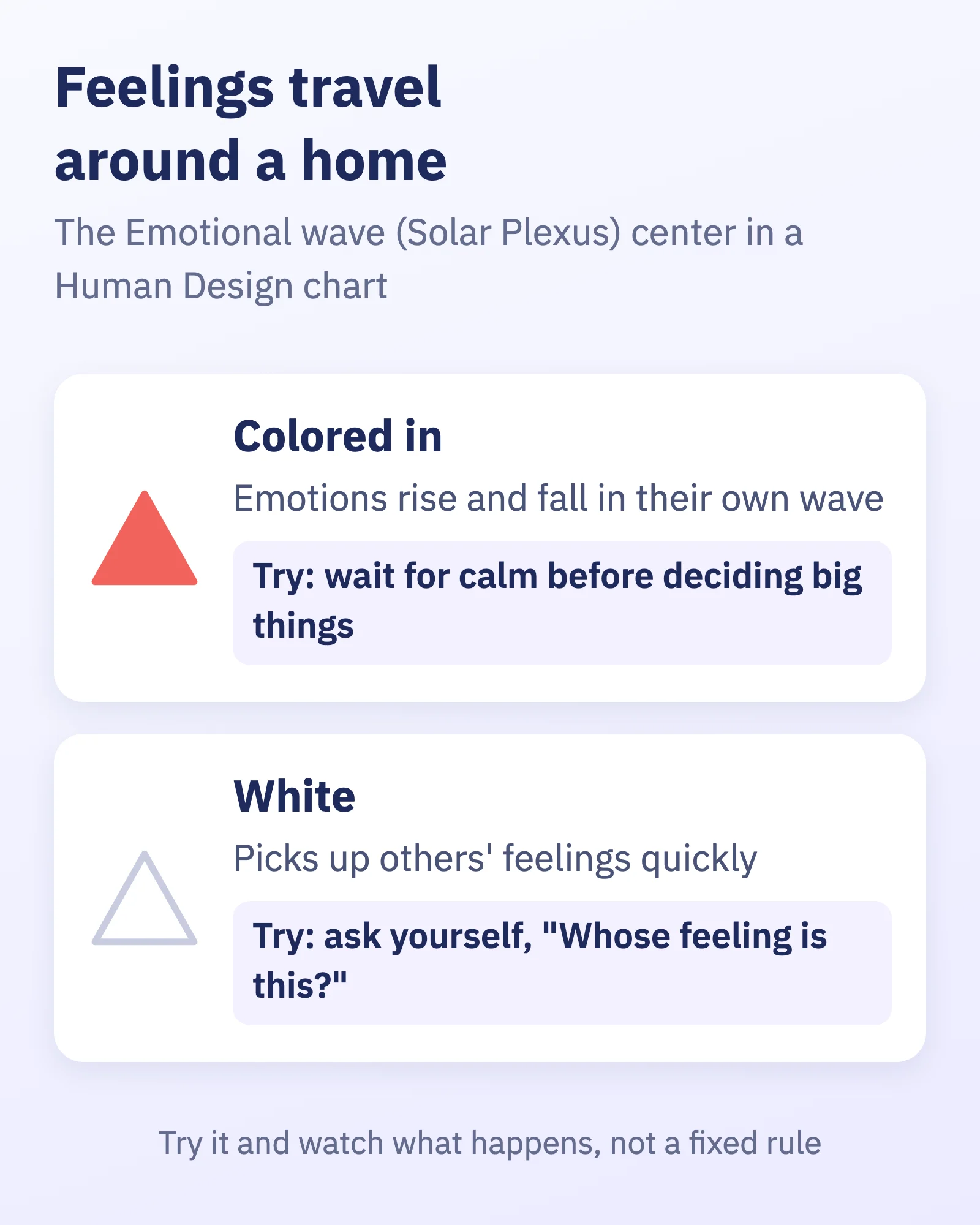
Knowing this can shift the question at home from "Why are you like this?" to "Where are we different, and how can we live together more easily?" To see which centers are colored in your own chart, read How to read a Human Design chart.
Just to be clear, this is one more lens to try. There's no research confirming it. Try it, watch what happens with the people in your home, and set it aside if it doesn't fit. You know your own home best.
In Family Blueprint, we turn each family member's chart into an energy guide in plain language. You can add yourself, your partner, your kids and your own parents, and compare where you take things in differently, as a starting point for talking again. See an example on the Human Design chart page.
Curious what your child is like?
Family Blueprint calculates an energy chart for everyone at home and writes it up as an easy-to-read guide for noticing and talking together.
Start freeSee plans and pricesIf it's too heavy to solve at home, reach out for help
If there is physical harm or threats at home, if someone seems sad or anxious for a long time and is struggling to get through the day, or if the fighting leaves your kids scared, please don't carry it alone. Talk to a psychiatrist, a psychologist or a family therapist. In Thailand you can call the Department of Mental Health hotline at 1323 or the social assistance center at 1300. If anyone may be in danger right now, call 191 or 1669 right away. Outside Thailand, call your local emergency number. Reaching out early is a way of taking care of everyone at home.
This article is a perspective for reflection and learning. It is not a diagnosis and does not promise any result.
Questions parents often ask
What are the most common family problems?
Many homes deal with repeated fights over chores, talking less, different parenting styles, money, and built-up tiredness. Most of them start as small things that never got talked about and kept growing.
Does arguing in front of our kids hurt them?
Kids seeing their parents disagree sometimes happens in every home. What matters is not using harsh words, not pulling the kids in to pick a side, and letting them also see the adults come back, talk kindly and apologize. But if the fights are frequent and heavy, or your kids seem scared, see the section on getting help above and talk to a professional.
What if my partner won't talk at all? Where do I start?
You can start from your side. Pick a time when you're both calm, bring up one thing briefly, and share how you feel and what you'd like, rather than who's to blame. If you've tried many times and still can't talk, having a psychologist or family therapist guide the conversation is a good option.
Try your family's energy guide
Add the birth date, time and place of the people at home, then read the ideas that fit each of them. Try one at a time and keep only what works for your family.
Start freeSee plans and pricesHave a question about this?
Ask other parents and the Family Blueprint team in our community. Read what other homes asked first, no sign-up needed.
Ask in the communityRelated situations, with words you can use
 Grandparents parent differently: what helpsGrandparents parent differently? Your child may be confused about whose rules to follow, and may feel uneasy seeing the adults they love upset with each…
 Asked to help, they moan and don't: what helpsAsked to help, they moan and don't? Chores can feel boring, and your child is used to adults doing them. Being asked out of the blue mid-rest feels unfa…
 Shouting “I hate you!” when angry: what helpsShouting “I hate you!” when angry? Your child has a huge feeling and not enough words, so “Hate” is the strongest one they can grab. Deep down, they may…
Keep reading
 Manifesting Generator in Human Design: for parents and kidsWhat is a Manifesting Generator in Human Design? Why some people juggle many things, move fast and skip steps, and how to make that energy easier at home.
 How to find yourself when you don't know what you likeHow to find yourself when you feel lost and don't know what you like: five small ways to start noticing yourself again, for working adults, parents and teens.
 Manifestor in Human Design: what it means for parents and kidsWhat is a Manifestor in Human Design? Why some kids want to start things themselves, how telling first helps at home, and what anger may signal.