Manifestor in Human Design: what it means for parents and kids

The question "what is a Manifestor?" often comes up after a scene like this.
Your child was just about to tidy up their toys. Then you say "time to clean up," and they put everything down, cross their arms and say, "I know! I was just doing it!" A tiny moment turns into a big one, when they would probably have tidied up on their own if you hadn't said a word.
Or maybe it's you. An idea comes and you act on it right away: moving furniture late at night, or settling the whole trip plan in your head. Then everyone at home looks puzzled and asks, "Why didn't you tell us first?"
If the word Manifestor has turned up in your child's Human Design chart, or yours, and you want to know what it means in real life, let's go through it together: what this start-it-yourself energy looks like at home, and a few things you can pick up and try.
If Human Design is brand new to you, you might like to read What is Human Design? A beginner's guide first.
What is a Manifestor, in short
Human Design sorts people into five types, and Manifestor is one of them. In the Family Blueprint app the Thai name is นักบุกเบิก, roughly "the pioneer." Human Design says only about one in ten people are Manifestors, so many families aren't used to this kind of energy.
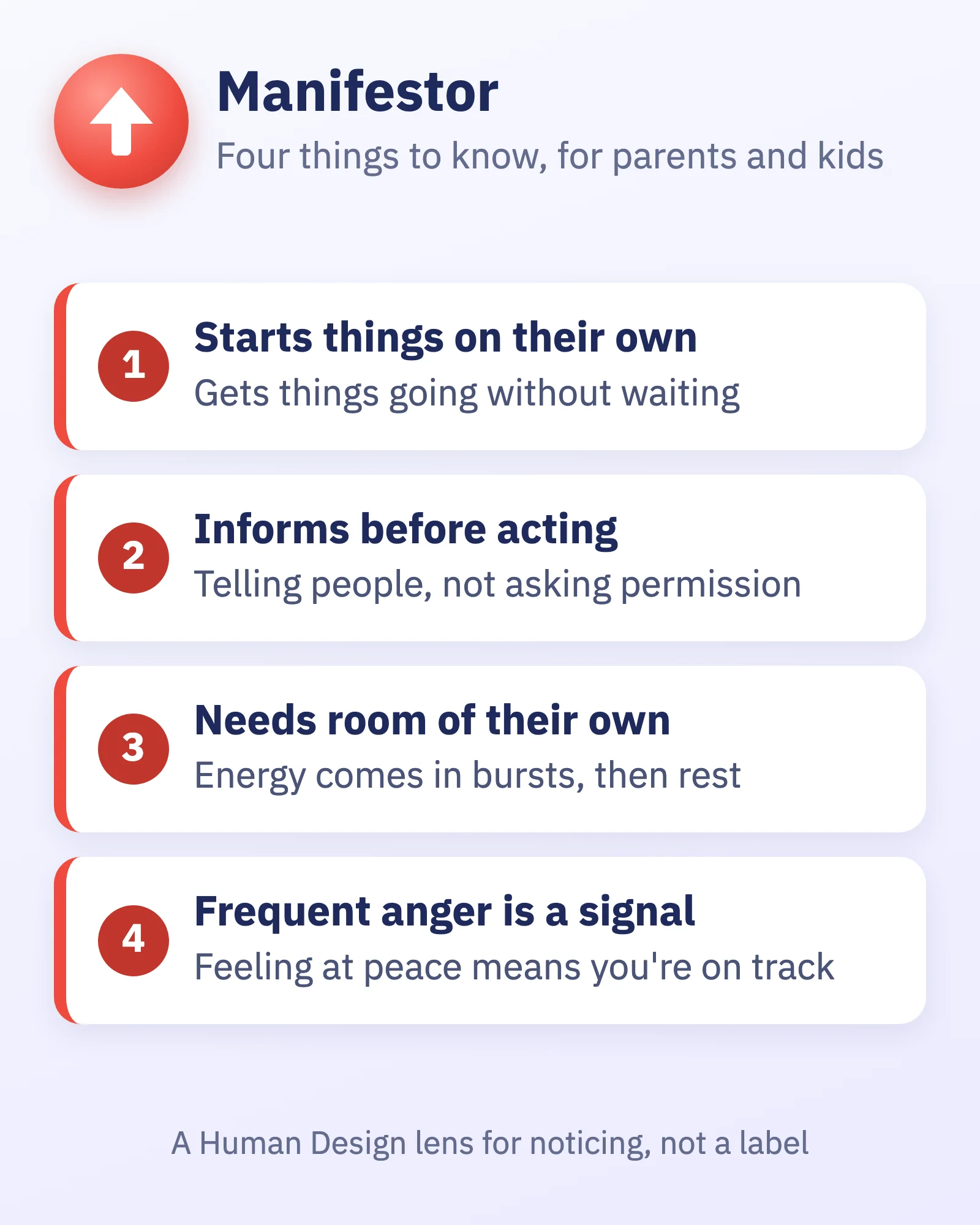
From Human Design's point of view, Manifestors tend to stand out in a few ways:
- They start new things on their own. They don't need anyone to invite them, and they're often the spark that gets something new going at home.
- They inform before acting. People around them can be caught off guard by this energy. Saying what they're about to do usually makes things go more smoothly, and that's about letting people know, not waiting for permission.
- They need room of their own. Their energy tends to come in bursts. They give it everything, then need quiet time to themselves.
- Frequent anger is a signal. If anger shows up a lot, it may be worth checking whether they're being blocked or controlled. A sense of peace is the sign they're on track.
Type comes from the actual chart, not from guessing who's stubborn or who likes to lead. A Manifestor is someone whose Sacral center (the life-force center) is white, while a motor center such as the Root, Solar Plexus or Heart connects to the Throat center (the communication center), either directly or through other centers. If the Sacral is white and there's no connection like that, the person is a Projector instead (or a Reflector, if every center in the chart is white). If the Sacral is colored in and there is such a connection, they're a Manifesting Generator. To see where to look, read How to read a Human Design chart.
If your child is a Manifestor, notice these four things
You don't have to believe every point. Hold each one up against the child you see every day, and set aside any that don't fit.
1. Share the plan ahead, then let them choose where to start
Many Manifestor kids want to start things themselves and dislike being told what to do step by step. Instead of giving orders in the moment, try sharing the big picture first: "We're leaving in half an hour. Teeth, clothes, shoes. Start with whichever you like." Then take one step back. Try it for two or three mornings and see whether there's less tugging back and forth.
2. Invite them to tell you first, instead of asking permission for everything
Try a simple house rule: "If you're about to do something big, tell us first." For example, before dragging every cushion in the house into a fort, or before carrying the whole toy box into another room. When they come and tell you, listen and thank them for telling you. "Tell me what you're going to play, okay?" sounds very different from "Why didn't you ask first?" to a child who wants to be the one who starts things.

3. Let them lead sometimes
When you play together, let your child set up the game or suggest the weekend plan once in a while. It's fine for you to be the follower. Kids with this starter energy often light up when their idea actually happens.
4. If they get angry often, check whether they're being interrupted
Sometimes the anger comes from being called away, stopped or having plans changed suddenly while they're in the middle of something. Try giving a five-minute heads-up before they need to stop. And while they're angry, don't rush to teach. Just say, "I'm right here," and wait. The limits stay the same: it's okay to be angry, but not okay to hit people or throw things.
If you're a Manifestor parent
Manifestor parents are often the ones who think of something and do it. There's always something new happening in the house. But sometimes the rest of the family can't keep up, and it starts to make you angry that nobody seems to get it.
Here are three things to try:
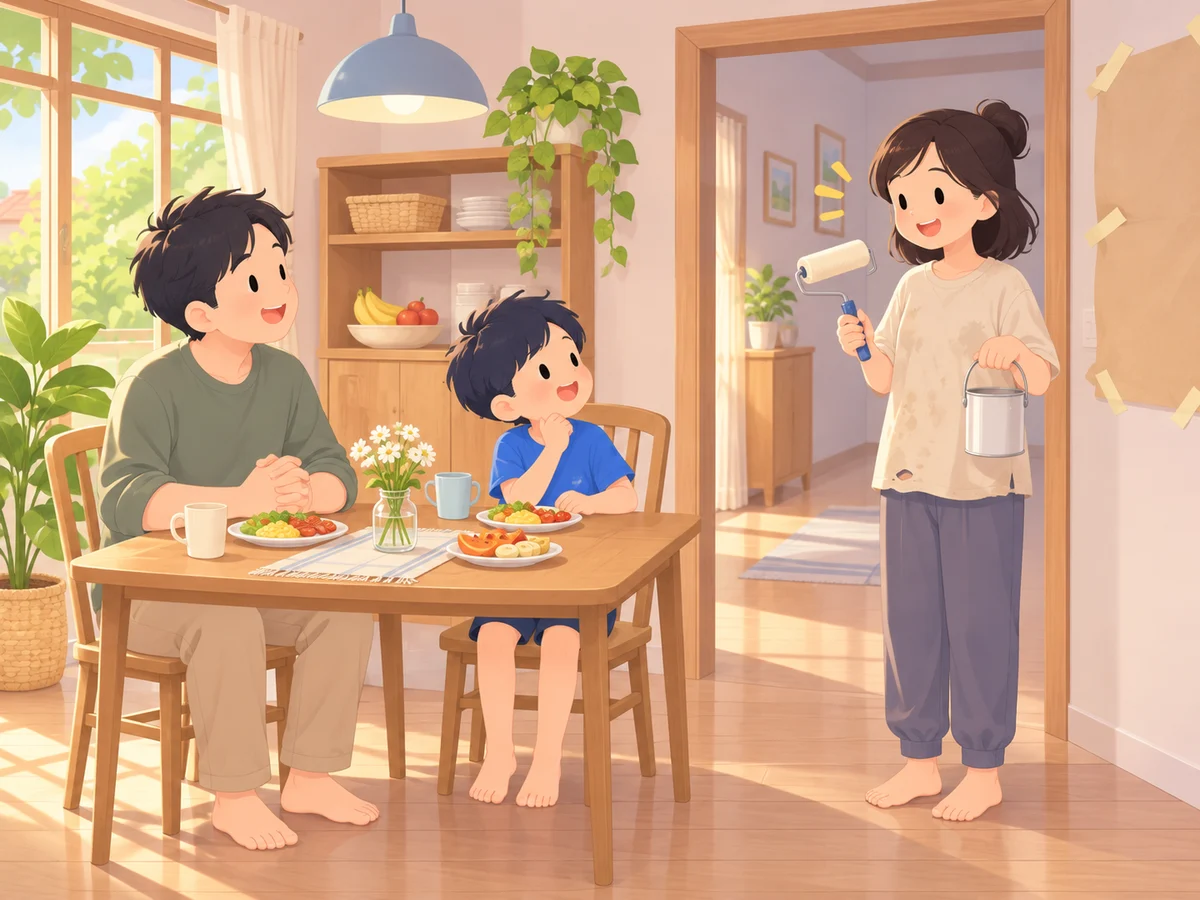
- Say one sentence before you start. Before starting anything that affects others at home, say briefly what you're going to do, like "I'm painting the dining room wall today." Your kids feel like part of it, and nobody gets a surprise later.
- Ask for a little time to yourself during the day. Ten minutes when nobody calls you. No need to feel guilty. Let the family know you're taking a short break, then come back.
- Notice what you get angry about. Jot down on your phone for a week when the anger shows up, then talk it over with someone you trust. You may see a pattern: being interrupted halfway, or feeling managed.
Telling first versus asking permission
Many parents worry about this. If a child just "tells" and then goes ahead, won't the house end up with no rules?
The difference is this: asking permission means waiting for someone else to decide, while telling means letting the people involved know before you act. Kids still need rules and adult care suited to their age, like every child. But for things your child can choose, making room for them to tell you first, instead of having to ask about everything, may help them cooperate more, and you still know what they're about to do. Start with small things and adjust as you go.
How to use the Manifestor idea without worry
Human Design is an energy system, and science hasn't backed it up. So I use it as one more lens for looking at my child. Please don't use it as a reason a child can do whatever they want "because they're a Manifestor," or to label them as difficult. A chart doesn't decide who your child is, and neither do our hopes for them. Raising kids is trying things and adjusting as we go.
If you want to know whether there's a Manifestor in your home, the chart will tell you more clearly than guessing from who argues best. Family Blueprint works out a chart for everyone at home from their birth details, and you can read it as an energy guide, one chapter at a time. Have a look first at Human Design chart.
Curious what your child is like?
Family Blueprint calculates an energy chart for everyone at home and writes it up as an easy-to-read guide for noticing and talking together.
Start freeSee plans and pricesWhen you're worried, talk to a professional
If your child gets angry so often and so strongly that someone gets hurt, they find it very hard to calm down, or it's affecting school and daily life, don't put it down to their chart type. Talk with a pediatrician or a child psychologist. A chart can help you understand your child better, but it can't replace a check by a professional.
This article is a perspective for reflection and learning. It is not a diagnosis and does not promise any result.
Questions parents often ask
What's the difference between a Manifestor and a Manifesting Generator?
Both have a motor center connected to the Throat. The difference is the Sacral center. A Manifestor's Sacral is white, so their energy tends to come in bursts, with rest in between. A Manifesting Generator's Sacral is colored in, so they usually have energy for longer stretches, and Human Design suggests they start by responding to what comes to them. You can read more about Sacral energy in Generator in Human Design.
If my child is a Manifestor, should I let them do whatever they want?
No. Rules about safety and bedtime are still the parents' call, suited to your child's age. What you can adjust is how you say things, like giving a heads-up instead of an instant order, and leaving room for your child to choose where they can.
I've been teaching my child to tell me first, but they keep forgetting. What can I do?
That's normal for kids. Adults forget too. Try modeling it often yourself, like "I'm going out front to water the plants." Kids tend to learn more from what they see us do than from what we tell them. And praise them every time they remember.
Try your family's energy guide
Add the birth date, time and place of the people at home, then read the ideas that fit each of them. Try one at a time and keep only what works for your family.
Start freeSee plans and pricesHave a question about this?
Ask other parents and the Family Blueprint team in our community. Read what other homes asked first, no sign-up needed.
Ask in the communityRelated situations, with words you can use
 You say no, and they do it again: what helpsYou say no, and they do it again? Your child is exploring what happens next. Memory and the brakes on impulses are only just starting to grow, so “No” d…
 Asked to help, they moan and don't: what helpsAsked to help, they moan and don't? Chores can feel boring, and your child is used to adults doing them. Being asked out of the blue mid-rest feels unfa…
 Hitting or biting when upset: what helpsHitting or biting when upset? Your child can't put feelings into words fast enough yet. When angry or losing something they love, hands move before word…
Keep reading
 Manifesting Generator in Human Design: for parents and kidsWhat is a Manifesting Generator in Human Design? Why some people juggle many things, move fast and skip steps, and how to make that energy easier at home.
 Family problems and solutions you can start at homeCommon family problems, from the same old fights to talking less and running on empty, and five small solutions you can start at home today, one step at a time.
 How to find yourself when you don't know what you likeHow to find yourself when you feel lost and don't know what you like: five small ways to start noticing yourself again, for working adults, parents and teens.