When your child doesn't understand you, and growing up feels like growing apart

Your kid gets home from school, walks right past you and shuts the bedroom door.
You ask, "How was your day?"
"Fine."
At dinner you all sit at the same table, each looking down at a phone.
And you remember when they were little and ran to tell you everything, faster than you could keep up.
If it feels like your child doesn't understand you, like anything you say just sounds like nagging to them, or if you're the grown-up child who feels your parents never really got you, this one is written for both sides.
First, drifting apart as a child grows up doesn't mean there's less love. Most of the time the child is busy becoming their own person, while we're still talking to them the way we did when they were small. So both sides end up on different frequencies.
Here are five things to try. You don't need all of them. Pick the one that feels closest to your home and start there.
1. See the need for space as part of growing up
Teenagers want their own room, their own thoughts, and some things they're not ready to share yet. That's normal for the age. A closed door doesn't mean a closed heart.
Instead of knocking and asking again and again, try saying it once: "If you want to talk, I'm downstairs." Then really wait. Keep up the small things you've always done, like dropping off a plate of fruit or calling them for dinner. It tells them your side of the door is still open.
2. Ask less, be nearby more
Questions like "What did you learn today?" or "Why are you home so late?" every single day start to feel like an interrogation, and the answers get shorter and shorter.
Look for time side by side, where nobody has to stare at anybody. Cooking together, a drive, watching the show they like. A lot of teenagers bring up the important stuff while their hands are busy with something else. Just listen, and don't rush in with the next question.

3. Listen the way you'd want to be listened to
When they tell you about friends, school or something that bugged them, our advice tends to come out before they've finished. We mean well. But an older kid often hears it as "they're not listening again."
Try asking first: "Do you want help figuring it out, or do you just want me to listen?" Then do what they say. If you disagree, ask "What do you think?" and hear the whole reasoning, the way you'd listen to another adult. You don't have to agree with everything. They just need to know their thinking has a place in the home.
4. Share your worry, not only your rules
Plenty of kids feel misunderstood because all they ever hear are the rules, never the reason behind them.
Try saying the real feeling out loud: "I ask what time you'll be home because I can't sleep until I know you're safe." A line like that lets them see their parent as a regular person who worries, not just someone who says no.
And if a fight goes badly and you said something you regret, you can always go back and say, "I didn't talk to you well yesterday. I'm sorry." Parenting is trying, getting it wrong, and adjusting. Relationships can be repaired. If you're not sure where to begin, talk it through with your partner or a friend you trust first. Saying it out loud often shows you the way.
5. If you're the child who feels your parents don't understand you
This one is for grown-ups. Our parents grew up in a very different time. In many homes, nobody says "I love you" out loud. It comes out as "Have you eaten yet?", as a meal cooked for you, or as worry that sometimes sounds a lot like complaining.
Start small. Tell them one real thing about your life, or ask what their life was like when they were your age. Simple questions like that help a lot of people see their parents in a new light.
For the things you want to decide yourself, you can say it gently: "I'd like to make this call myself, but I'll keep you posted." You can understand your parents without agreeing on everything. They may not change right away either, and that's okay.

How Human Design looks at parents and children who don't understand each other
Human Design is an energy-based system that sees each person as taking in the world, making decisions and using energy differently. If it's new to you, start with What is Human Design? A beginner's guide.
From this angle, parents and kids who don't understand each other may simply be talking in the way that suits them, rather than the way that suits the other person. As kids grow up and do more things their own way, those differences show more clearly. A few ideas to try:
- Generators and Manifesting Generators often find it easier to answer short yes-or-no questions than long ones that need explaining. More in What is a Generator?
- Projectors tend to open up when someone asks for their view and sees who they are, more than when they're being taught. More in What is a Projector?
- Manifestors often like to start things on their own. Homes often run smoother when you agree they'll tell you before they act, rather than asking permission for everything.
- Reflectors often take longer than others with big things. Not pushing for an answer the same day may make talking easier.
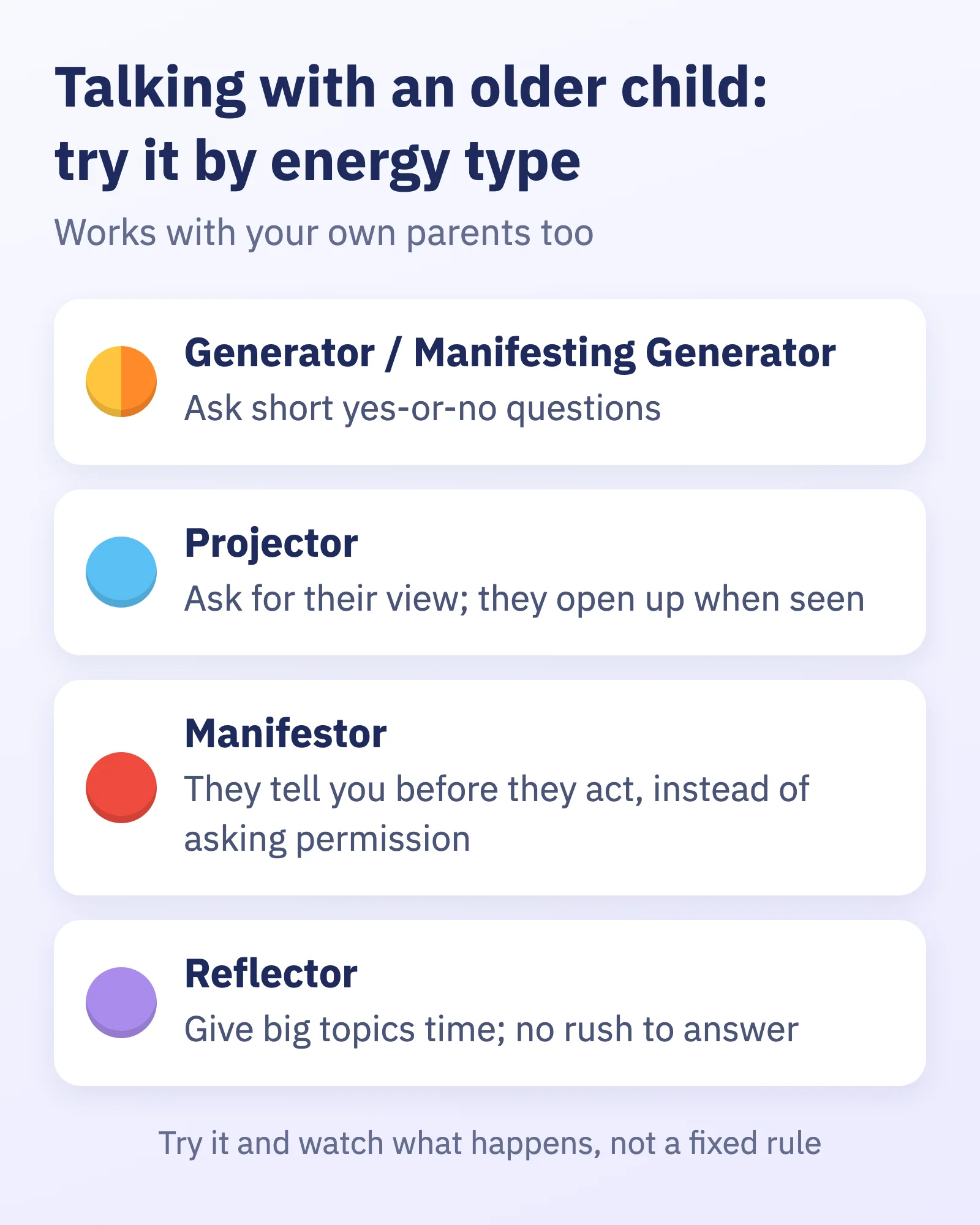
Just to be clear, this is one more lens to try. There's no research confirming it. Try it, see what happens with the people in your home, and set it aside if it doesn't fit. You know your child and your parents better than anyone. If your child is still young, When parents don't understand their child is a good companion read.
In Family Blueprint, we turn each person's chart into a plain-language energy guide, and you can add your child, yourself and your own parents, then compare where you take things in differently. It's a starting point for talking again. See a sample chart at Human Design chart.
Curious what your child is like?
Family Blueprint calculates an energy chart for everyone at home and writes it up as an easy-to-read guide for noticing and talking together.
Start freeSee plans and pricesIf the distance worries you, reach out to a professional
If your child has withdrawn and stopped talking to anyone for a long time, seems sad or anxious for weeks, eats or sleeps very differently, drops noticeably at school, or talks about hurting themselves, don't wait. Talk to a child and adolescent psychiatrist or a psychologist, or call 1323, the mental health hotline of Thailand's Department of Mental Health. If they may be in danger right now, stay with them, don't leave them alone, and call 1669 or go to a hospital. Outside Thailand, call your local emergency number. And if you're an adult and what's happening at home feels too heavy to carry alone, talking with a psychologist can help too.
This article is a perspective for reflection and learning. It is not a diagnosis and does not promise any result.
Questions parents often ask
My teenager won't talk to me at all. Should I just ask directly?
You can. Ask once, keep it short, and let them choose when: "If you want to tell me, I'm right here." Then keep finding time side by side with no agenda. Many kids open up on their own when they're ready.
Does my child not understanding me mean I raised them wrong?
Not necessarily. While a child is becoming their own person, disagreements happen in almost every home. What helps is slowly adjusting how you talk to fit the older child they've become, rather than looking for who's to blame.
I'm an adult, and every visit home ends in an argument with my parents. What can I do?
Start with things that feel easy to share, like a meal together or asking about their younger days. Park the topics you strongly disagree on for now, and state your boundaries gently. You don't have to win every point to understand each other.
Try your family's energy guide
Add the birth date, time and place of the people at home, then read the ideas that fit each of them. Try one at a time and keep only what works for your family.
Start freeSee plans and pricesHave a question about this?
Ask other parents and the Family Blueprint team in our community. Read what other homes asked first, no sign-up needed.
Ask in the communityRelated situations, with words you can use
 Shut in their room, barely talking: what helpsShut in their room, barely talking? Your child may not be avoiding Mum or Dad so much as wanting their own space after a long day. Their room is where t…
 Shouting “I hate you!” when angry: what helpsShouting “I hate you!” when angry? Your child has a huge feeling and not enough words, so “Hate” is the strongest one they can grab. Deep down, they may…
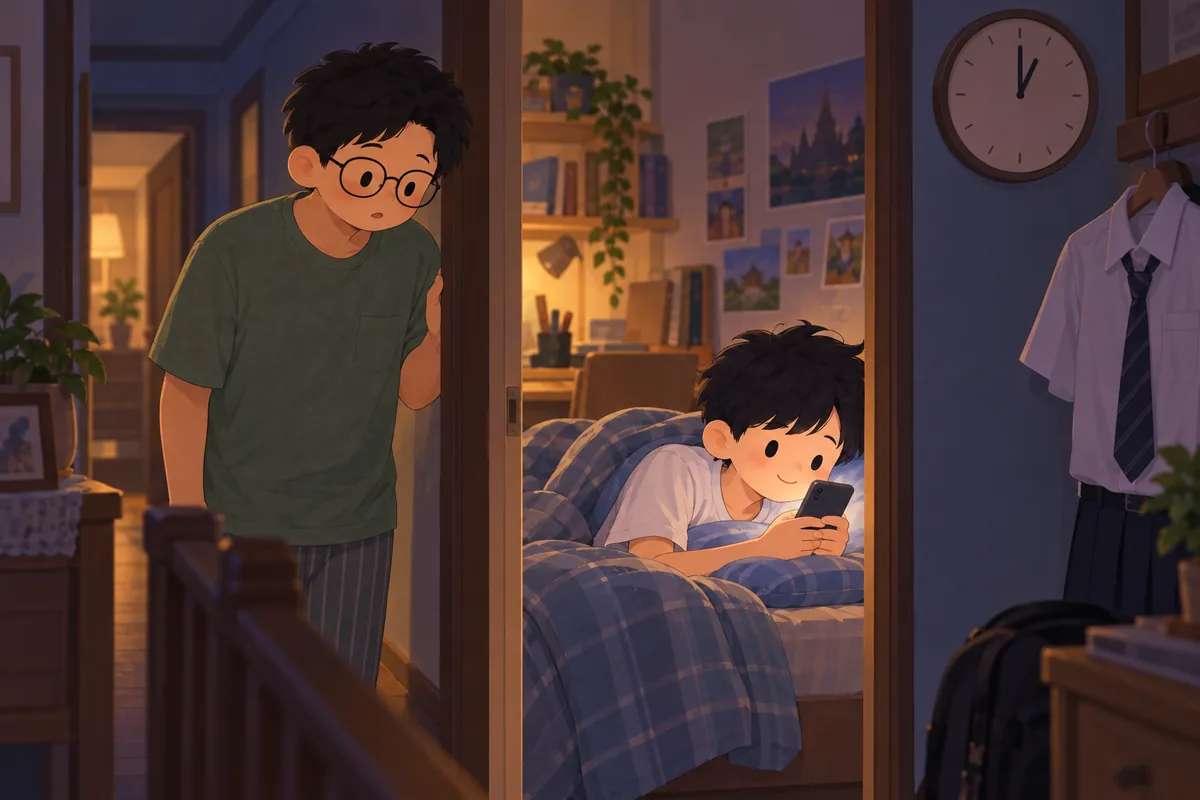 On the phone late, can't get up: what helpsOn the phone late, can't get up? A teen's body clock really does shift later, so your child may not feel sleepy at 10 p.m. Night is also the only time t…
Keep reading
 Manifesting Generator in Human Design: for parents and kidsWhat is a Manifesting Generator in Human Design? Why some people juggle many things, move fast and skip steps, and how to make that energy easier at home.
 Family problems and solutions you can start at homeCommon family problems, from the same old fights to talking less and running on empty, and five small solutions you can start at home today, one step at a time.
 How to find yourself when you don't know what you likeHow to find yourself when you feel lost and don't know what you like: five small ways to start noticing yourself again, for working adults, parents and teens.